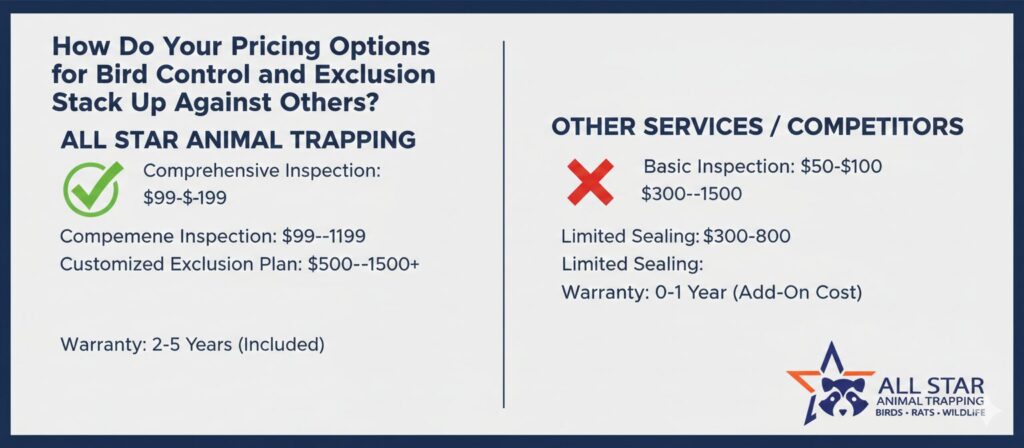
Bird infestations can disrupt business operations, damage property, and create health hazards. For any commercial or residential space, understanding how to manage and prevent bird intrusions is crucial. Knowing how your pricing options for bird control and exclusion stack up against others can save both time and money while ensuring effective results.
Bird control and exclusion are not just about removing birds but implementing long-term solutions. These solutions range from physical barriers to deterrents, each with its own cost implications. Comparing pricing options helps make informed decisions, ensuring that you invest in solutions that offer value without compromising on quality.
Understanding Bird Control Pricing Options
Effective bird control starts with understanding the pricing models available. Most service providers offer a mix of consultation, installation, and ongoing maintenance. Knowing how your pricing options for bird control and exclusion stack up against others involves assessing these elements carefully.
Some companies charge flat rates, while others base pricing on property size, infestation severity, and the type of birds. By comparing these models, you can determine which approach aligns with your budget and long-term control strategy.
Key Factors That Influence Bird Control Costs
Several factors determine how pricing for bird control and exclusion is structured.
- Property Size: Larger properties require more materials and labor, impacting overall costs.
- Type of Birds: Different species require different methods of exclusion.
- Infestation Severity: Heavy infestations may need multiple interventions.
- Materials Used: Nets, spikes, and deterrent devices vary in cost.
- Maintenance Requirements: Some solutions need regular upkeep to remain effective.
Understanding these factors helps you evaluate how your pricing options for bird control and exclusion stack up against others and ensure fair value for the services provided.
Comparing Service-Based vs. Product-Based Pricing
Bird control services often fall into two pricing categories: service-based and product-based. Service-based pricing includes labor, installation, and ongoing monitoring, while product-based pricing focuses on the cost of deterrents or exclusion tools.
Service-based options typically offer a more comprehensive approach, covering the entire process from assessment to maintenance. Product-based solutions may appear cheaper upfront, but can incur additional costs if installation or maintenance is required.
Service-Based Packages
Service-based packages often include inspection, removal, and preventive measures. This pricing ensures professional handling of complex infestations. Choosing a reliable service can save you significant time and reduce the risk of recurring issues.
Product-Based Solutions
Product-based solutions, like spikes, nets, and repellents, provide a DIY approach. They are cost-effective for minor infestations but may lack the long-term efficiency of professional services. Evaluating how your pricing options for bird control and exclusion stack up against others requires considering these trade-offs.
Combination Models
Many companies offer a hybrid approach, combining products and professional services. This balances upfront costs with effectiveness and long-term maintenance. Understanding these models allows for a tailored approach suitable for specific property needs.
Physical Barriers and Their Cost Implications
Physical barriers, such as bird nets, spikes, and wire systems, are the cornerstone of exclusion strategies. These solutions prevent birds from accessing critical areas while requiring minimal maintenance.
- Bird Nets: Flexible, cost-effective for large areas.
- Bird Spikes: Ideal for ledges and rooftops; moderate cost.
- Wire Systems: Effective for long-term deterrence; higher upfront cost.
- Cables and Tracks: Adjustable solutions for industrial and commercial spaces.
Comparing the cost of these barriers helps determine how your pricing options for bird control and exclusion stack up against others, ensuring the right balance of affordability and efficiency.
Advanced Deterrent Technologies
Modern bird control also includes electronic and visual deterrents. These solutions often carry higher upfront costs but can offer long-term savings.
Electronic devices emit ultrasonic sounds or use motion detection to scare birds. Visual deterrents, like reflective tapes and predator decoys, create an inhospitable environment for birds. Evaluating these options against traditional physical barriers can reveal how your pricing options for bird control and exclusion stack up against competitors.
Ultrasonic Devices
Ultrasonic devices target birds with high-frequency sounds. They are safe for humans and pets and can cover large areas. Cost depends on the coverage area and the number of devices needed.
Visual Deterrents
Visual deterrents simulate predators or create light reflection effects. These are low-maintenance, cost-effective solutions for minor infestations. Integrating them into a comprehensive strategy can enhance overall results.
Automated Systems
Automated bird deterrent systems combine motion sensors, lights, and sound. Though expensive, they offer minimal human intervention. Assessing pricing for these solutions ensures they provide long-term value compared to traditional methods.
Labor and Installation Charges
Labor and installation are significant components of total costs. Experienced technicians ensure proper placement and effectiveness of exclusion tools.
Understanding how your pricing options for bird control and exclusion stack up against others involves reviewing labor costs in relation to the complexity of the job. Proper installation reduces the risk of recurring infestations and additional expenses.
Maintenance and Ongoing Support Costs
Bird control is not a one-time investment. Regular inspections, cleaning, and repairs are necessary to maintain effectiveness.
- Scheduled inspections to identify new infestation points.
- Replacement of damaged barriers or deterrents.
- Updating technology-based deterrents for optimal performance.
- Seasonal adjustments for migratory bird patterns.
- Emergency interventions for sudden infestations.
Considering these ongoing costs provides a clear picture of how your pricing options for bird control and exclusion stack up against others in the long run.
Choosing the Right Provider for Cost Efficiency
Selecting a provider is not just about the lowest price but also the value offered. Evaluate experience, service scope, and guarantees.
- Verify company experience and certifications.
- Request detailed quotes, including materials and labor.
- Check customer reviews and past project results.
- Assess warranty and follow-up services.
These steps help ensure that how your pricing options for bird control and exclusion stack up against others aligns with quality, not just cost.
Customizing Solutions for Specific Needs
Every property and bird infestation is unique. Customized solutions often offer the best balance between cost and effectiveness.
- Conduct site-specific inspections to identify high-risk areas.
- Choose exclusion methods suitable for the property layout.
- Combine multiple deterrent technologies for maximum impact.
- Schedule regular monitoring based on bird activity patterns.
Custom solutions ensure that pricing is fair and performance-oriented, making your pricing options for bird control and exclusion stack up against others more favorably.
Evaluating Cost vs. Long-Term Benefits
Short-term savings may not always translate into long-term efficiency. Investing in proper solutions reduces damage, health risks, and recurring costs.
- Proper installation prevents property damage.
- Effective deterrents reduce the risk of disease transmission.
- Maintenance plans avoid emergency interventions.
- Durable materials extend the lifespan of exclusion tools.
Assessing how your pricing options for bird control and exclusion stack up against others ensures that financial decisions are sustainable and result-oriented.
Common Misconceptions About Bird Control Pricing
Many businesses assume the cheapest option is always the best. However, hidden costs and inefficiencies often emerge later.
- DIY solutions may require repeated purchases.
- Low-cost materials may not withstand environmental conditions.
- Inexperienced labor can cause installation errors.
- Lack of maintenance plans increases long-term costs.
Understanding these misconceptions helps you accurately compare how your pricing options for bird control and exclusion stack up against others.
Conclusion
Evaluating pricing for bird control and exclusion requires a comprehensive understanding of services, products, labor, and maintenance. By analyzing these factors, businesses can make informed decisions that optimize costs while ensuring effective control. Proper planning and comparison safeguard both investment and property integrity.
Investing in high-quality, customized solutions not only addresses current infestations but also prevents future problems. Knowing how your pricing options for bird control and exclusion stack up against others empowers you to select strategies that offer long-term value and peace of mind.
FAQs
1. How do I know if professional bird control is worth the price?
Professional services provide long-term solutions and reduce recurring costs. They ensure proper installation and maintenance.
2. Are DIY products effective for all types of birds?
DIY solutions are typically best for minor infestations. Larger or aggressive species often require professional intervention.
3. How often should bird control maintenance be done?
Maintenance is recommended at least twice a year. Severe infestations may need quarterly checks.
4. Do electronic deterrents affect humans or pets?
Most devices are safe for humans and pets. They emit high-frequency sounds that only birds can hear.
5. Can combining multiple methods reduce costs?
Yes, combining barriers, deterrents, and maintenance often provides better long-term savings.
6. What factors most influence pricing for bird control?
Property size, type of birds, infestation severity, and materials used.
7. Is it cheaper to use product-based solutions than services?
Product-based solutions may be cheaper initially. However, professional services can prevent repeated costs.
8. How do I compare pricing between providers?
Review the breakdown of materials, labor, and maintenance. Evaluate long-term effectiveness alongside upfront costs.
Humane Wildlife Removal You Can Trust
When nuisance wildlife becomes a problem, rely on All Star Animal Trapping for professional and humane animal removal services. We safely remove raccoons, skunks, squirrels, rodents, and more — protecting your home and family the right way.