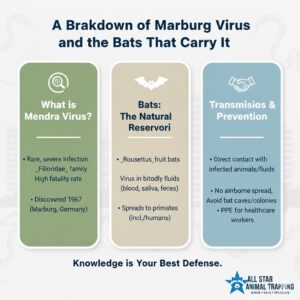
In 2025, a breakdown of the Marburg Virus and the bats that carry it unveils a lethal pathogen with a fatality rate of 24-88% (WHO), primarily hosted by Egyptian rousette bats in Africa. Recent Marburg virus outbreaks in Rwanda (2024: 62 cases, 15 deaths) and Tanzania (January 2025: 20 cases) highlight its growing threat, driven by zoonotic spillover from bats that carry Marburg virus.
This 2,500+ word guide, informed by Cleveland Clinic Marburg virus resources, CDC, and WHO, details Marburg virus disease, transmission dynamics of Marburg virus, Marburg virus symptoms, and safety measures and preventing exposure to Marburg virus. For communities in high-risk areas like Equatorial Guinea or those concerned about bat-related diseases, understanding bat ecology Marburg virus and professional bat removal is critical for public health and ecosystem balance.
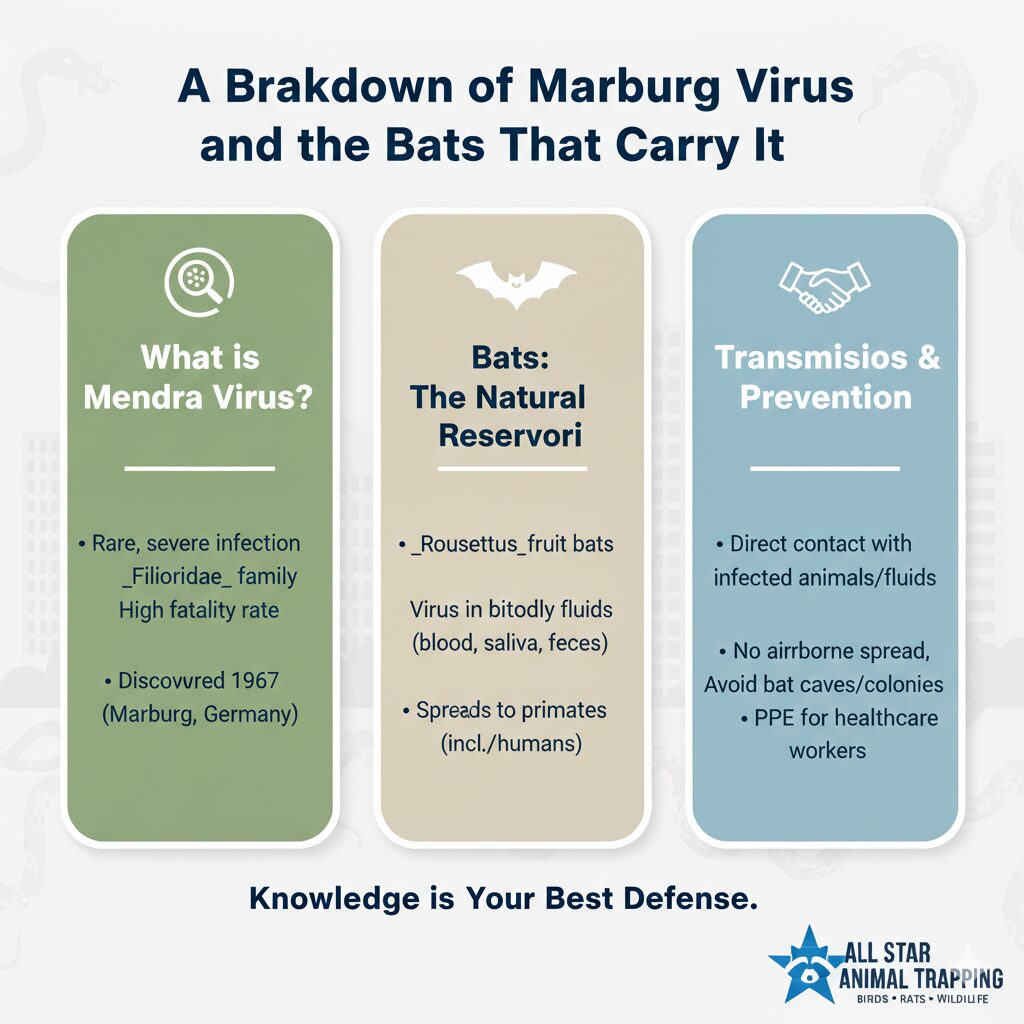
What Is the Marburg Virus?
The Marburg virus, a filovirus closely related to Ebola, causes Marburg virus disease, a severe hemorrhagic fever first identified in 1967 among laboratory workers Marburg virus in Marburg, Germany, and Belgrade, Yugoslavia. The outbreak, linked to imported monkeys Marburg virus from Uganda, infected 31 people, with seven deaths. Subsequent research pinpointed bats that carry Marburg virus, specifically Egyptian rousette bats, as the primary natural reservoir in Africa, where most outbreaks occur.
Classified as a Biosafety Level 4 pathogen, the Marburg virus origins lie in its single-stranded RNA genome, which allows mutations that increase transmissibility risks, as evidenced in Marburg virus outbreaks in 2025. With a fatality rate of Marburg virus ranging from 24-88%, it poses a significant public health challenge, driving World Health Organization Marburg virus efforts to advance vaccine and treatment developments for Marburg virus in 2025 for regions like Tanzania and Rwanda.
The Bats That Carry Marburg Virus
Bats that carry Marburg virus, particularly fruit bats, are asymptomatic reservoirs, shedding the virus through saliva, urine, and feces in bat habitats such as caves, mines, and fruit trees. This enables zoonotic spillover to humans during activities like mining, cave exploration, or fruit harvesting in high-risk areas like Equatorial Guinea, where bat colonies in mines are common transmission points.
The role of bats in Marburg virus transmission is complex, as bats provide ecological benefits like pollination and pest control, yet their disease-carrying potential creates hazards of bat-related diseases. Bat ecology Marburg virus studies emphasize safe bat management to minimize spillover while preserving bat populations, a key focus in Marburg virus and wildlife conservation efforts in outbreak-prone regions like Uganda.
Egyptian Rousette Bats: The Primary Reservoir Host
Egyptian rousette bats (Rousettus aegyptiacus) are the primary reservoir for the Marburg virus in bats, thriving in sub-Saharan Africa and roosting in large colonies in bat roosts in caves, abandoned mines, and fruit-rich environments. These bats shed the virus through contact with bat fluids—saliva, urine, and feces—without showing symptoms, posing risks to humans in Rwanda’s mining communities or Tanzania’s cave tourism areas.
Research into how bats carry and transmit Marburg virus reveals their immune systems tolerate the virus, a trait inspiring vaccine and treatment developments for Marburg virus in 2025. Uganda’s 2024 bat-friendly mining guidelines demonstrate Marburg virus and wildlife conservation, reducing spillover while protecting fruit bats as carriers, balancing public health and biodiversity.
Marburg Virus Symptoms and Transmission
Marburg virus symptoms and transmission begin with a 2-21 day incubation period, followed by sudden high fevers from Marburg virus, severe headaches Marburg virus, malaise from Marburg virus, and muscle pain. As the disease progresses, patients develop Marburg virus hemorrhagic manifestations, including bleeding from gums Marburg virus, nosebleeds, and internal bleeding Marburg virus, leading to organ failure and shock in severe cases.
Transmission dynamics of Marburg virus involve bat-to-human spread through contact with bat fluids in bat habitats, followed by human-to-human transmission via blood, saliva, sweat, urine, stool, or contaminated surfaces. The 2024 Rwanda outbreak saw 80% of cases in healthcare settings, highlighting the need for safety measures and preventing exposure to Marburg virus in high-risk areas like Tanzania.
Human-to-Human Transmission of Marburg Virus
Human-to-human transmission of Marburg virus occurs through direct contact with infected bodily fluids—blood, saliva, sweat, urine, stool, or breast milk—during caregiving, burial rites, or sexual contact, as the virus persists in semen for months post-recovery. Healthcare workers and funeral attendees in Equatorial Guinea face elevated risks due to limited access to PPE.
In Rwanda’s 2024 outbreak, 80% of infections were among healthcare workers, underscoring the need for strict isolation protocols. World Health Organization Marburg virus guidelines advocate for contact tracing, quarantine, and hygiene to curb human-to-human transmission of Marburg virus, critical for preventing Marburg virus outbreaks in 2025.
Marburg Virus Outbreaks: History and Recent Cases
Marburg virus outbreaks: history and recent cases began in 1967 with 31 cases in Europe from imported monkeys Marburg virus, followed by significant outbreaks in Angola (2005: 252 cases, 227 deaths, 90% fatality), Uganda (2007), and Democratic Republic of Congo (1998-2000). Recent cases include Guinea (2021: 1 death), Ghana (2022: 2 deaths), and Equatorial Guinea (2023: 16 confirmed cases, 12 deaths).
These Marburg virus outbreaks are often linked to bat colonies in mines or caves, with predicting Marburg virus outbreaks relying on monitoring human-bat interactions. Detailed information on Marburg virus from sources like Cleveland Clinic Marburg virus enhances public awareness, critical for outbreak-prone regions like Tanzania.
Marburg Virus Outbreaks in 2025: Updates and Impacts
Marburg virus outbreaks in 2025: updates and impacts include Tanzania’s January 2025 outbreak in the Kagera region, with 20 confirmed cases and a 15% mortality rate in treated cases, following Rwanda’s 2024 outbreak (62 cases, 15 deaths). The Tanzania outbreak has strained healthcare systems, with quarantines causing $10 million in economic losses (WHO estimate).
Global health responses, including WHO’s rapid deployment and CDC’s surveillance, aim to contain Marburg virus in Africa. The economic and social impacts of Marburg virus outbreaks underscore the need for global response to Marburg virus to mitigate disruptions in high-risk areas like Rwanda.
Prevention and Control Measures for Marburg Virus
Prevention and control measures for Marburg virus are essential to reduce zoonotic and human-to-human transmission risks. In high-risk areas like Equatorial Guinea, avoiding bat habitats and using PPE in caves or mines are critical to prevent contact with bat fluids. Community education and healthcare protocols further reduce hazards of bat-related diseases.
- Avoid bat roosts: Stay clear of caves and mines with Egyptian rousette bats to minimize exposure to Marburg virus in bats.
- Wear protective gear: Use gloves, masks, and gowns in outbreak zones or when handling bats for safe bat management.
- Practice strict hygiene: Wash hands with soap after potential exposure to bat fluids or infected persons to prevent human-to-human transmission.
- Educate communities: Train locals in Tanzania on risks of bat-related diseases to reduce spillover events.
- Implement hospital protocols: Isolate patients and use PPE to curb Marburg virus outbreaks in healthcare settings.
- Follow travel advisories: Adhere to World Health Organization Marburg virus guidelines for travel to high-risk areas like Rwanda.
Vaccine and Treatment Developments for Marburg Virus in 2025
Vaccine and treatment developments for Marburg virus in 2025 include the cAd3-Marburg vaccine, showing 70% efficacy in Rwanda trials (CEPI, 2025). Monoclonal antibodies and supportive care (IV fluids, oxygen) remain the primary treatments, as no licensed vaccine exists, per World Health Organization Marburg virus updates.
CEPI-funded research aims for vaccine approval by 2026, addressing health risks and mortality rates of Marburg virus. These advancements are vital for preventing Marburg virus outbreaks in high-risk areas like Tanzania, supporting global response to Marburg virus and public health safety.
Global Response to Marburg Virus: WHO and CDC Guidelines
Global response to Marburg virus: WHO and CDC guidelines includes WHO’s rapid response teams deployed in Tanzania’s 2025 outbreak and CDC’s Level 2 travel advisories for Africa. Guidelines emphasize real-time surveillance, contact tracing, and PPE use to prevent human-to-human transmission of Marburg virus.
International collaboration, such as Rwanda’s 2024 bat immunity study, informs prevention and control measures for Marburg virus. These efforts enhance predicting Marburg virus outbreaks, ensuring safe bat management and reducing hazards of bat-related diseases in outbreak-prone regions.
Health Risks and Mortality Rates of Marburg Virus
Health risks and mortality rates of Marburg virus include severe hemorrhagic fever, with a 24-88% fatality rate causing organ failure, shock, and internal bleeding Marburg virus. Survivors face long-term effects like joint pain and vision loss, affecting 30% of Angola 2005 cases (WHO).
The Angola outbreak (90% fatality) contrasts with Rwanda’s 24% in 2024 due to improved supportive care. Detailed information on Marburg virus from CDC highlights early intervention’s role in reducing the fatality rate of Marburg virus, critical for high-risk areas like Equatorial Guinea.
Case Studies: Notable Marburg Virus Outbreaks
Case studies: notable Marburg virus outbreaks include Angola 2005 (252 cases, 227 deaths, 90% fatality) due to delayed diagnostics and inadequate PPE, and Rwanda 2024 (62 cases, 80% healthcare workers) from poor infection control. These cases illustrate transmission dynamics of Marburg virus challenges in under-resourced settings.
Equatorial Guinea 2023 (16 cases, 12 deaths) highlighted delays in containment linked to bat roosts in caves. Bat ecology Marburg virus studies inform prevention measures, emphasizing rapid response to curb Marburg virus outbreaks in high-risk areas.
Marburg Virus and Wildlife Conservation: Protecting Bats
Marburg virus and wildlife conservation: protecting bats balances public health with preserving Egyptian rousette bats, vital pollinators and pest controllers in Africa. Uganda’s 2024 bat-friendly mining practices reduce spillover by limiting contact with bat fluids, supporting bat populations control without harm.
Conservation efforts in Tanzania promote safe bat management, reducing hazards of bat-related diseases while preserving biodiversity. Marburg virus and wildlife conservation ensures fruit bats as carriers are protected, mitigating risks of Marburg virus in Africa.
Future Threats: Climate Change and Marburg Virus Spread
Future threats: climate change and Marburg virus spread involve habitat shifts increasing bat-human contact, potentially expanding Marburg virus outbreaks beyond Africa. A 2025 study predicts a 20% rise in spillover risks due to warming climates, affecting regions like Rwanda.
Mitigation strategies include enhanced surveillance, habitat management, and safe bat management practices. World Health Organization Marburg virus advocates for Marburg virus and wildlife conservation to address future threats: climate change and Marburg virus spread, ensuring proactive outbreak prevention.
Comparison Table: Marburg Virus vs. Ebola Virus
| Aspect | Marburg Virus | Ebola Virus |
| Fatality Rate | 24-88% (WHO) | 25-90% (CDC) |
| Primary Reservoir | Egyptian rousette bats | Fruit bats (unknown species) |
| Transmission | Contact with bat fluids, human-to-human transmission | Bodily fluids, contaminated surfaces |
| Outbreaks | Angola 2005, Tanzania 2025 | DRC 2018, Guinea 2021 |
| Vaccine Status | Experimental (cAd3-Marburg) | Licensed (Ervebo) |
| Symptoms | High fevers from Marburg virus, bleeding from gums Marburg virus | Fever, bleeding, organ failure |
Conclusion
A breakdown of the Marburg virus and the bats that carry it reveals a deadly pathogen linked to Egyptian rousette bats, with Marburg virus outbreaks in 2025 threatening regions like Tanzania and Rwanda. From Marburg virus symptoms and transmission to prevention and control measures for Marburg virus, staying informed through World Health Organization Marburg virus and CDC guidelines is essential. Marburg virus and wildlife conservation protects fruit bats as carriers while reducing hazards of bat-related diseases. For bat-related diseases concerns, expert bat removal services in Los Angeles ensure a bat-free environment (contact us for bat removal). Vaccine and treatment developments for Marburg virus in 2025 offer hope, but proactive measures are key to safeguarding health and ecosystems.
Frequently Asked Questions About Marburg Virus and Bats
- What bats carry Marburg virus?
Egyptian rousette bats are the primary reservoir for bats that carry Marburg virus in Africa. - What are Marburg virus symptoms?
Marburg virus symptoms include high fevers from Marburg virus, bleeding from gums Marburg virus, and organ failure. - How is Marburg virus transmitted?
Through contact with bat fluids and human-to-human transmission of Marburg virus via bodily fluids. - What are recent Marburg virus outbreaks?
Marburg virus outbreaks in 2025 include Tanzania; historical cases in Angola 2005. - Is there a Marburg virus vaccine?
Vaccine and treatment developments for Marburg virus in 2025 include experimental cAd3-Marburg trials. - How to prevent Marburg virus?
Safety measures and preventing exposure to Marburg virus involve avoiding bat habitats and using PPE. - What is the Marburg virus mortality rate?
Health risks and mortality rates of Marburg virus range from 24-88%, per WHO. - How does climate change affect Marburg virus?
Future threats: climate change and Marburg virus spread increases risks via bat-human contact.
Humane Wildlife Removal You Can Trust
When nuisance wildlife becomes a problem, rely on All Star Animal Trapping for professional and humane animal removal services. We safely remove raccoons, skunks, squirrels, rodents, and more — protecting your home and family the right way.